Sold!
Antique Toy Banks, Vintage Photography, Political Memorabilia & More
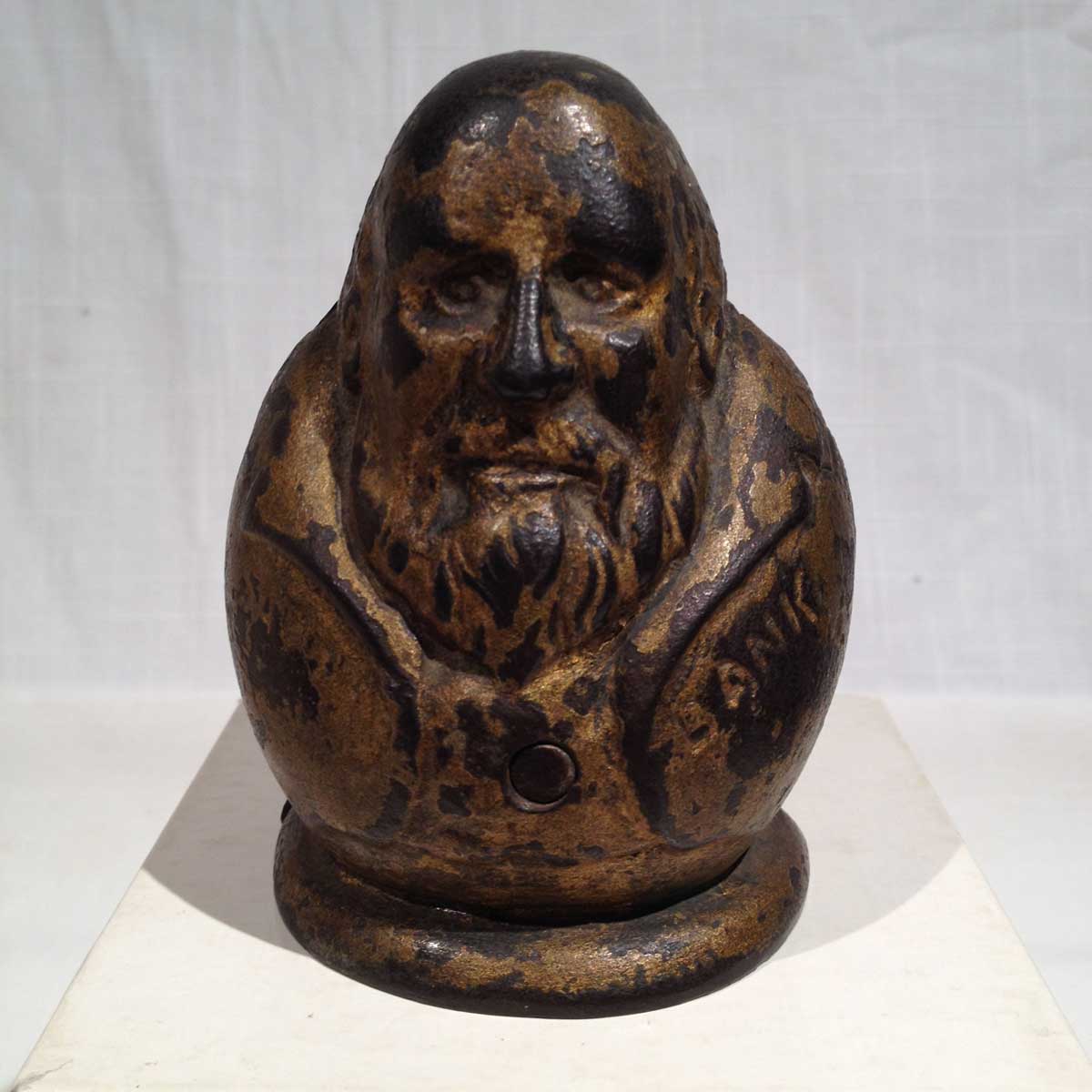
Tammany Tiger & Boss Tweed Cast Iron Still Bank
Original 1870's extremely rare Tammany Tiger & Boss Tweed cast iron still bank. The bank depicts the Tammany Tiger on the back side & Boss Tweed of famous corrupt politician fame on the front side.
An example of this bank is listed & pictured in the Still Bank Book by Andy Moore on page # 69 item # 110. In the Moore book he gives the date of manufacture as 1873 & the maker as unknown. An example of this bank is also pictured in the book "Political Banks" by Bob and Shirley Peirce on page #58. In the Peirce book the value is given as $8,000. to $12,000. & mention is made of an example which sold at auction for $8,750. & another example which sold at auction for over $14,000.
The bank is complete & all original with no repairs, no replacement components, & no touch ups. The bank shows wear to the original gold paint. But, the majority of the original paint still remains.
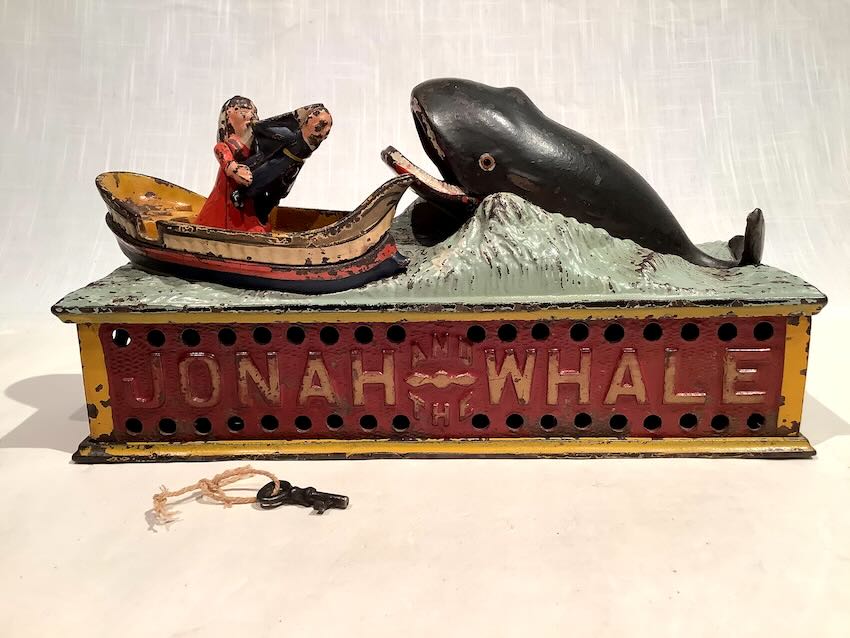
Jonah & the Whale Mechanical Bank
Original cast iron toy "Jonah and the Whale" mechanical bank. The bank was designed by Peter Adams & was patented on 15 July 1890. This bank was made by the Shepard Hardware Company in Buffalo, N. Y. circa 1890's or so.
The mechanical action of the bank is in superb working order. The rectangular locking trap is original & is in fine working order. The cast iron key to open & close the trap is of the correct design & is a well made recast key.
Otherwise, except for the key, the bank is completely original, in all respects, including all of the paint. The bank is complete & is in sound operating condition. There are no chips, no cracks, & no repairs to the iron. There are no touch-ups to the paint anywhere on the bank. The painted finish shows some minor wear from use. But, the vast majority of the all original bright & superb painted finish is still present. This is a bank which is quite hard to find in all original condition & with this much original paint still present.

Curly Toed Billiken Iron Still Bank
Extremely rare variation of a Billiken cast iron still bank. There are several different versions of Billiken iron still banks which turn up frequently & are fairly common. However, In 56 years of being heavily involved with antique iron banks we have never seen another example in any book or in any collection of this version of Billiken.
We are estimating the bank to date circa 1910-1920's or so.
We do not know the maker of this bank. But, we are guessing that this may possibly have been produced by an English toy company. One reason that we say this is that the coin slot is of ample size to accept large English pennies as well as some other large English coins. The coin slot is larger on this bank than the coin slots seen on standard common American versions of Billiken banks. Additionally, for the size, this bank is heavier than other slightly larger Billiken banks made which are of American manufacture.
This example is all original including the original screw. There is considerable wear to the original paint. But, all of the paint present on the bank is entirely original in all respects.

Civil War General Thomas W. Sweeny Signed CDV Photo
An original 1860's Civil War cdv sepia albumen photo of General Thomas William Sweeny. An appealing seated pose with excellent contrast. The photo is ink signed with rank "T. W. Sweeny Brig. Genl. Vols." The signature which was clipped from a larger piece was affixed, in period, to the front bottom of the photo. A tiny bit of the bottom of the "g" in Brig. is gone from when the clipped signature was attached to the cdv.
This is an authentic autograph in the hand of General Thomas W. Sweeny & it is guaranteed entirely original in all respects.
The back has the photographer's marking "Charles D. Fredericks & Co. "Specialite," 587 Broadway, New York."
This cdv was from a 98 piece collection of cdv photos that was formed during the Civil War and slightly after by General George Hampden Crosman & his wife. The Crosman album contained a number of scarce & elusive cdvs of Union generals as well as a number of cdvs of Union generals with original autographs.

Clock with Movable Pendulum Still Bank, Arcade c. 1923
Original circa 1923 clock with movable pendulum cast iron still bank. The bank is listed as number 1540 on page 136 in the Andy Moore "Penny Bank Book". In the Moore book he lists the bank as having been made by the Arcade Company & he lists as circa 1923. The Arcade Toy Co. was located in Freeport, Illinois. The bank measures 5 5/8 inches tall by 3 1/4 inches across the front of the base. The weight is 15.1 ounces.
This elaborate bank is beautifully made. It is in gorgeous glossy superb truly exceptional all original condition. The bank has only minor wear. All of the paint present is entirely original & there are no touch ups to the paint. There are no cracks, no chips, no replaced components, & no repairs. The pendulum & the wires holding the pendulum wires are all guaranteed 100% in all respects. An exceptionally pleasing example of a bank that is very hard to find in this lovely condition.

1860’s General George A. Custer Civil War Brady CDV Photo
An original 1860's Civil War cdv sepia albumen photo of General George Armstrong. This Brady image was from a negative which combines of the head of Custer from life with his uniform from an engraving. The back has the photographer's marking "Published by E. & H. T. Anthony, 501 Broadway, New York. from photographic negative in Brady's National Portrait Gallery".
This cdv was from a 98 piece collection of cdv photos that was formed during the Civil War and slightly after by General George Hampden Crosman & his wife.

Washington 1928 Pinback Button P. O. S. Of A. Martinsburg, PA
Original 1 1/4 inch diameter pinback Patriotic Order of Sons of America button with ribbon suspension. The absolutely gorgeous button design has Washington at the center. Definitely one of the most beautiful early button designs that we have seen. The red, white, & blue ribbon has the wording "Central Penna. Assn. P. O. S. of A. Martinsburg, Pa. July 14th 1928".

1890-1891 Tower Iron Still Bank with Dial
A pleasing, finely cast, & extremely appealing "1890-1891 TOWER" iron still bank. This bank is listed & an example is pictured in the Andy Moore still bank book on page 118 item #1198. This bank was produced by the Kyser & Rex Co. of Frankford, Pa. as mentioned in the Moore book. Clearly the castings are of the very fine quality that Kyser & Rex is known for.
On the front of the door the original brass combination lock has letters for the positions in the combination. Underneath the bank incised in the casting is the wording :" Pat. Apld For 475 ".
Underneath the bank there is an old penciled inscription which we are unable to read & and also there is an old paper label.
One of the superior achievements of design & casting quality produced by the renown Kyser & Rex Company of Frankford, Pa.

German Bing Tin Windup Toy Touring Car
Original Bing German long tin toy windup touring car. This toy is circa 1910-1916 or so & was made by the Bing Toy Company in Germany. The toy has the maker's marking on the back end which is "G B N" in a rectangle with rays which is the marking of Gebruder Bing of Nurnberg, Germany.
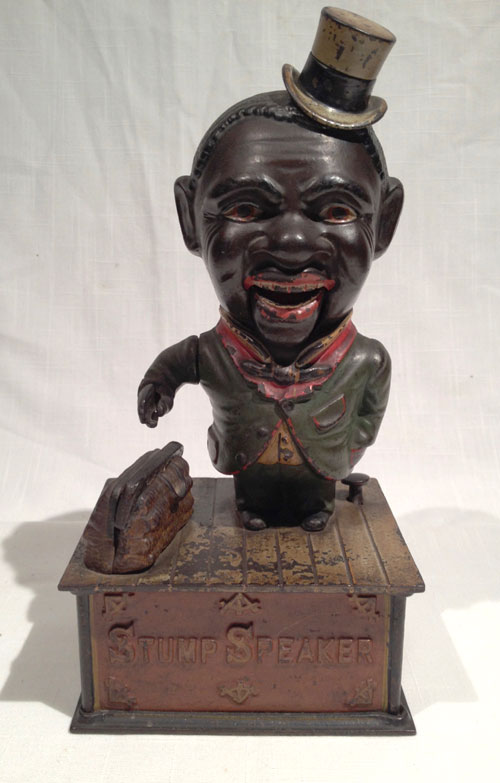
Stump Speaker Cast Iron Mechanical Bank
Original Stump Speaker cast iron mechanical bank. This bank was patented in 1886 & was designed by Charles G. Shepard & Peter Adams, Jr. The bank was manufactured by the Shepard Hardware Company of Buffalo, New York.

A. C. Williams Gasoline Truck
Original circa 1936 red cast iron toy “Gasoline” truck made by the A. C. Williams Toy Company of Ravenna, Ohio. This toy gas truck has all original rich red paint with original gold highlights to the details & is in excellent condition.

German Tin Windup Toy Saloon Car c. 1910-1918
Original Bing German 7.5 inches long tin toy windup saloon car. This red & black tin toy car dates circa 1910-1916 or so. The toy does not have any maker's marking. However, we believe that the car was made by the Gebruder Bing Toy Co. of Nurnberg, Germany. The reason that we say this is that we have seen a couple of German tin cars in the past which had a Bing maker's marking & the identical detachable headlamps.

1892-1893 Columbian World’s Fair Medal by Boldenweck Co. in Original Box
This is an interesting 1892-1893 Columbian World's fair medal. This is a very elaborate medal which was issued by & is marked on the edge: "Boldenweck & Co. Pat'd Oct. 7 1890".
This is the white metal plain edge version listed as HK #157 in the "So-Called Dollars" book. It has a diameter of 2 9/32 inches inches & has a weight of 2.2 ounces.
The medal has wonderful & colorful natural toning. Our example is in proof-like AU on the obverse & proof-like uncirculated on the reverse. The medal is still contained in it's original cardboard box of issue.
The original box has a partial damaged & incomplete label. The box lid has heavy wear, separations at the corners, & flaws to the lid. The bottom of the box is sound & tight.
The box interior still retains the original red cotton insert as issued. This medal was recently found in an early estate from New Jersey where it had been carefully sequestered for the last 127-126 years since it's issue in 1892-1893.

1858 People’s Anti-LeCompton N.J. Political Campaign Ballot, Kansas Anti-Slavery
This is a very rare "People's Anti-Lecompton" political party campaign paper ticket which we have been informed is a New Jersey 3rd District Ballot. This historically important anti-slavery connected ticket was issued circa 1858.
The ticket has "For Congress, Garnet B. Adrain, For Assembly, Charles Scranton, For Sheriff, William Sweeny, For Coroners, Robert Little, Robert Galloway, Gideon C. Angle”. Garnet B. Adrain was the U.S. Representative of the 3rd District from 1857 to 1861.
Here is background information relating to the Lecompton Constitution which will serve to inform as to the historical significance of this important & fragile little bit of paper:
The Lecompton Constitution (1857) was one of four proposed constitutions for the state of Kansas. It was drafted by pro-slavery advocates and included provisions to protect slaveholding in the state and to exclude free blacks from its bill of rights. It was overwhelmingly defeated on January 4, 1858 by a majority of voters in the Kansas Territory. The rejection of the Lecompton Constitution, and the subsequent admittance of Kansas to the Union as a free state, highlighted the irregular and fraudulent voting practices that had marked earlier efforts by bushwhackers and border ruffians to create a state constitution in Kansas that allowed slavery.

1904 N.J. Democratic Joel Parker Association Clam Bake Pinback Ribbon Badge
This is an elaborate pinback badge with original dark blue silk ribbon. This was issued for the: August 17, 1904 ”26th Clam Bake" & has the wording: "Member" "Joel Parker Association".
Joel Parker, a Democrat, served as governor of New Jersey from 1863 to 1866 and 1872 to 1875. Parker served as a justice on the New Jersey Supreme Court from 1880 to 1888. The badge has two fancy gilt brass bars at the top with celluloid strips that have wording about the clam bake.
This very rare & quite beautiful badge shows an image of Joel Parker printed on celluloid which is mounted in the middle of an ornate gilt brass shield.
Overall this rare & beautiful pinback ribbon badge, issued for this one day event, is in near mint condition. The only example ever seen by us in over 52 years of actively looking for early pinback buttons.
At the Democratic Convention in Freehold, N.J. in 1870, Parker gave a speech opposing the 15th Amendment. The 15th Amendment was adopted into the U.S. Constitution in early 1870 giving the right to vote to African American men. New Jersey was among the states that did not ratify the Amendment in 1870. New Jersey did not ratify the 15th Amendment until February 15, 1871.
In a newspaper clipping found online from the February 12, 1880 Monmouth Inquirer of Freehold, New Jersey, Parker’s opposition to the 15th Amendment in 1870 is mentioned along with his being sworn in before the United States Supreme Court to serve as a justice on the New Jersey State Supreme Court on February 2, 1880, the same day as an African American man also was sworn in. We tried to find the name of the African American man who was sworn in on that same day and to which court he was sworn in to but could not figure out who he was.
The address of the Joel Parker Association was 7 Commerce St. in Old Newark, New Jersey in 1893. In an August 20, 1903 newspaper article the Joel Parker Association is referred to as New Jersey’s leading Democratic organization which had celebrated its silver anniversary (25th) on the previous day with a clambake and an excursion to the Port au Peck on the Shrewsbury River. The pinback badge is one that would have been worn at the 1904 clambake.

1888 Harrison & Morton Tippecanoe Corps New Brunswick, N.J. Silk Ribbon
Rare silk presidential campaign ribbon dating from the 1888 campaign of Benjamin Harrison for president & Morton for vice president. The ribbon has their portraits in ovals & the wording: "1840-1888. The Veteran Tippecanoe Corps of New Brunswick, New Jersey." The "Tippecanoe" makes reference to the battle of Tippecanoe which took place on 7 November 1811 between the U.S. army forces led by general William Henry Harrison in the battle against the Shawnee Indians. William Henry Harrison, who was president only 31 days from 4 March 1841 - 4 April 1841, was Benjamin Harrison's grandfather.

General Winfield Scott Signed CDV
An original 1860's Civil War cdv sepia albumen photo of General Winfield Scott. The photo is ink signed "Winfield Scott". The signature which was clipped from a larger piece was affixed, in period, to the front bottom of the photo.
This is an authentic autograph in the hand of General Winfield Scott & it is guaranteed entirely original in all respects. The back has the photographer's marking "Photographed by F. Gutenkunst, 706 Arch Street. Philadelphia."
This cdv was from a 98 piece collection of cdv photos that was formed during the Civil War and slightly after by General George Hampden Crosman & his wife. The Crosman album contained a number of scarce & elusive cdvs of Union generals as well as a number of cdvs of Union generals with original autographs.

General Alexander Hays Signed Civil War CDV Photo
An original 1860's Civil War cdv sepia albumen photo of General Alexander Hays. The photo is ink signed with rank on the bottom front "Alex Hays. Brig Genl Vols. U. S. A." This is an authentic autograph in the hand of General Alexander Hays & it is guaranteed entirely original in all respects. The back has the printed photographer's marking "Henry Ulke, 278 Pennsylvania Avenue, Washington, D. C."
This cdv was from a 98 piece collection of cdv photos that was formed during the Civil War and slightly after by General George Hampden Crosman & his wife.